Loading…
Xeon
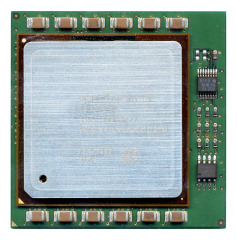
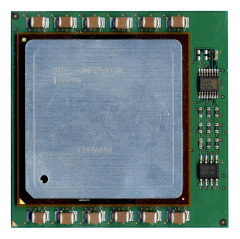
Launched in 2001The original Socket 603 Intel Xeon is the server and workstation implementation of Intel’s early NetBurst architecture, introduced in 2001 as a high-end derivative of the Pentium 4 and based initially on the 0.18 µm Foster core, later followed by the 0.13 µm Prestonia shrink, while preserving full IA-32 compatibility, SSE2 support, and NetBurst’s defining traits such as a very deep pipeline, trace cache, and double-pumped integer execution units optimized for high clock frequency. Unlike desktop Pentium 4 processors, Socket 603 Xeons were designed for multiprocessor platforms and enterprise workloads, using the Socket 603 interface with chipset support for dual-processor operation, larger memory capacities, and server-oriented I/O subsystems. Early Foster-based models typically carried 256 KiB of on-die L2 cache, while Prestonia increased this to 512 KiB and improved power efficiency through the process shrink, both relying on a 400 MT/s quad-pumped front-side bus. Technically, the original Socket 603 Xeon is best understood as the first mainstream NetBurst-based Xeon platform, bringing the Pentium 4 core architecture into Intel’s server space before the later Gallatin generation added larger L3 cache and more scalable high-end variants.